What is water pollution?
Water pollution can be defined in many ways. Usually, it means one or more substances have built up in water to such an extent that they cause problems for animals or people. Oceans, lakes, rivers, and other inland waters can naturally clean up a certain amount of pollution by dispersing it harmlessly. If you poured a cup of black ink into a river, the ink would quickly disappear into the river's much larger volume of clean water. The ink would still be there in the river, but in such a low concentration that you would not be able to see it. At such low levels, the chemicals in the ink probably would not present any real problem. However, if you poured gallons of ink into a river every few seconds through a pipe, the river would quickly turn black. The chemicals in the ink could very quickly have an effect on the quality of the water. This, in turn, could affect the health of all the plants, animals, and humans whose lives depend on the river.
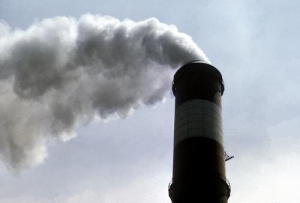
Photo: Pollution means adding substances to the environment that don't belong there—like the air pollution from this smokestack. Pollution is not always as obvious as this, however. Photo courtesy of US Department of Energy/National Renewable Energy Laboratory (DOE/NREL) (image id 6312198).
Thus, water pollution is all about quantities: how much of a polluting substance is released and how big a volume of water it is released into. A small quantity of a toxic chemical may have little impact if it is spilled into the ocean from a ship. But the same amount of the same chemical can have a much bigger impact pumped into a lake or river, where there is less clean water to disperse it.
Water pollution almost always means that some damage has been done to an ocean, river, lake, or other water source. A 1969 United Nations report defined ocean pollution as:
"The introduction by man, directly or indirectly, of substances or energy into the marine environment (including estuaries) resulting in such deleterious effects as harm to living resources, hazards to human health, hindrance to marine activities, including fishing, impairment of quality for use of sea water and reduction of amenities." [1]
Fortunately, Earth is forgiving and damage from water pollution is often reversible.
What are the main types of water pollution?
When we think of Earth's water resources, we think of huge oceans, lakes, and rivers. Water resources like these are called surface waters. The most obvious type of water pollution affects surface waters. For example, a spill from an oil tanker creates an oil slick that can affect a vast area of the ocean.
Not all of Earth's water sits on its surface, however. A great deal of water is held in underground rock structures known as aquifers, which we cannot see and seldom think about. Water stored underground in aquifers is known as groundwater. Aquifers feed our rivers and supply much of our drinking water. They too can become polluted, for example, when weed killers used in people's gardens drain into the ground. Groundwater pollution is much less obvious than surface-water pollution, but is no less of a problem. In 1996, a study in Iowa in the United States found that over half the state's groundwater wells were contaminated with weed killers. [2]
Surface waters and groundwater are the two types of water resources that pollution affects. There are also two different ways in which pollution can occur. If pollution comes from a single location, such as a discharge pipe attached to a factory, it is known as point-source pollution. Other examples of point source pollution include an oil spill from a tanker, a discharge from a smoke stack (factory chimney), or someone pouring oil from their car down a drain. A great deal of water pollution happens not from one single source but from many different scattered sources. This is called nonpoint-source pollution.

Photo: Above: Point-source pollution comes from a single, well-defined place such as this pipe. Below: Nonpoint-source pollution comes from many sources. All the industrial plants alongside a river and the ships that service them may be polluting the river collectively. Both photos courtesy of US Fish & Wildlife Service Photo Library.
When point-source pollution enters the environment, the place most affected is usually the area immediately around the source. For example, when a tanker accident occurs, the oil slick is concentrated around the tanker itself and, in the right ocean conditions, the pollution disperses the further away from the tanker you go. This is less likely to happen with nonpoint source pollution which, by definition, enters the environment from many different places at once.
Sometimes pollution that enters the environment in one place has an effect hundreds or even thousands of miles away. This is known as transboundary pollution. One example is the way radioactive waste travels through the oceans from nuclear reprocessing plants in England and France to nearby countries such as Ireland and Norway.
How do we know when water is polluted?
Some forms of water pollution are very obvious: everyone has seen TV news footage of oil slicks filmed from helicopters flying overhead. Water pollution is usually less obvious and much harder to detect than this. But how can we measure water pollution when we cannot see it? How do we even know it's there?
There are two main ways of measuring the quality of water. One is to take samples of the water and measure the concentrations of different chemicals that it contains. If the chemicals are dangerous or the concentrations are too great, we can regard the water as polluted. Measurements like this are known as chemical indicators of water quality. Another way to measure water quality involves examining the fish, insects, and other invertebrates that the water will support. If many different types of creatures can live in a river, the quality is likely to be very good; if the river supports no fish life at all, the quality is obviously much poorer. Measurements like this are called biological indicators of water quality.
What are the causes of water pollution?
Most water pollution doesn't begin in the water itself. Take the oceans: around 80 percent of ocean pollution enters our seas from the land. Virtually any human activity can have an effect on the quality of our water environment. When farmers fertilize the fields, the chemicals they use are gradually washed by rain into the groundwater or surface waters nearby. Sometimes the causes of water pollution are quite surprising. Chemicals released by smokestacks (chimneys) can enter the atmosphere and then fall back to earth as rain, entering seas, rivers, and lakes and causing water pollution. That's called atmospheric deposition. Water pollution has many different causes and this is one of the reasons why it is such a difficult problem to solve.

Comentarios
Publicar un comentario